Often overshadowed by mainstream gym apparatus, the Roman Chair, or Hyperextension Bench, is a precision fitness device purpose-built for posterior chain development. Unlike compound machines that disperse muscular tension, this specialized bench isolates and activates lumbar stabilizers, erector spinae, glutes, and hamstrings. Its streamlined structure eliminates redundant movement interference and spinal compression, delivering targeted full-range stimulation beyond the capacity of standard compound lifts. For fitness enthusiasts, athletes, and rehabilitation users, it is not merely an auxiliary tool but a core device for boosting spinal stability, fixing postural imbalances, and refining fundamental movement patterns.
Mechanical Structure and Ergonomic Design Logic
Exclusive Training Advantages for Posterior Chain Development
Scenario Adaptability and Long-Term Training Value
Mechanical Structure and Ergonomic Design Logic
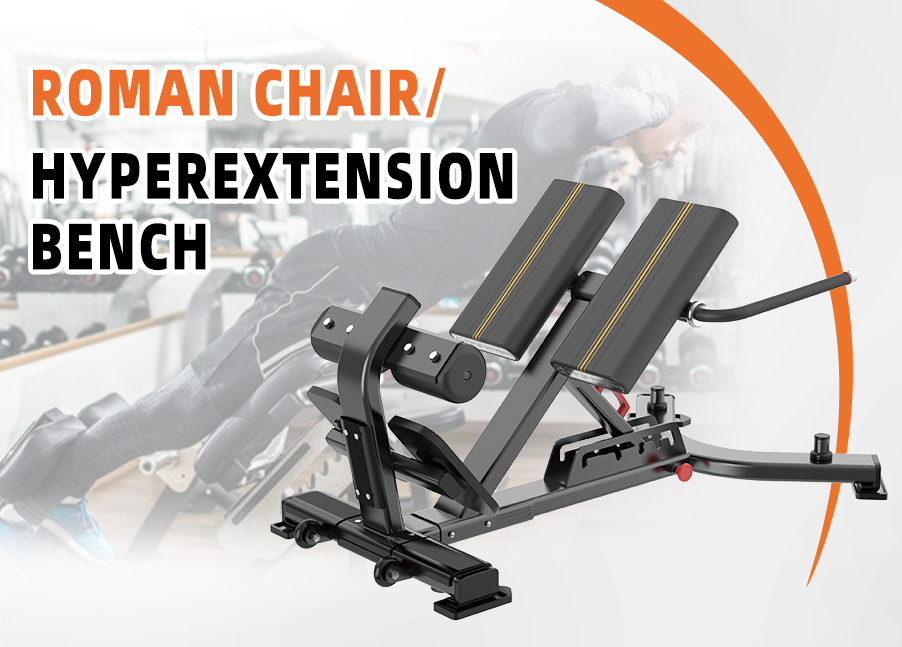
The hyperextension bench’s core value derives from its science-backed mechanical structure and ergonomic design, distinguishing it from ordinary training benches. Its reinforced steel frame and stable joints guarantee structural rigidity during dynamic torso flexion and extension, enabling safe, high-amplitude posterior chain training. The padded thigh and hip supports firmly anchor the lower body, limiting pelvic and leg compensatory movements while freeing the torso and spine for full motion, ensuring force acts precisely on target posterior muscles.
Most standard models feature a biomechanically optimized 45-degree incline, balancing training intensity and spinal safety by avoiding excessive vertical pressure and insufficient low-angle muscle activation. Adjustable pads fit diverse user heights and body types, while high-density padding reduces training friction and joint pressure. Foldable household designs save space, adapting to both commercial gyms and home fitness setups. Every structural detail is calibrated to standardize hip-hinge mechanics and ensure accurate, effective muscle stimulation.
Exclusive Training Advantages for Posterior Chain Development
Common compound lifts like squats and deadlifts improve overall lower-body strength but cannot effectively target deep spinal stabilizers and lumbar muscles. The hyperextension bench fills this critical training gap, specializing in systematic posterior chain strengthening. Its unique suspended torso design eliminates vertical spinal compression, allowing lumbar and posterior chain muscles to complete full-range stretching and contraction in a low-risk training environment that conventional back equipment cannot provide.
Biomechanical research verifies that hyperextension bench training fully activates glutes and hamstrings while engaging underdeveloped lumbar muscles neglected in regular workouts. Consistent training strengthens spinal stability and corrects sedentary postural issues such as anterior pelvic tilt and thoracic kyphosis. The equipment supports flexible progressive overload via torso angle adjustment, isometric holds, and weighted resistance, building muscle endurance, stability and explosive strength step by step. Its adaptable difficulty makes it suitable for beginners, professional athletes and rehabilitation users.
Scenario Adaptability and Long-Term Training Value
The hyperextension bench’s lasting popularity stems from its versatile scenarios and long-term health value. In professional strength training, it serves as a key injury-prevention tool: pre-workout hyperextensions activate the posterior chain and stabilize the spine, reducing lumbar injury risks during heavy compound lifts. Post-training low-intensity movements relieve spinal tension, relax tight posterior muscles and speed up recovery.
It also delivers outstanding performance in physical rehabilitation and home fitness. It safely strengthens weak lumbar muscles, alleviates mild strain and chronic back pain caused by insufficient core strength. For home gym users, its compact, multi-functional design covers posture correction, core stabilization and posterior chain shaping. Ultimately, the hyperextension bench optimizes human movement mechanics, builds solid spinal support, and supports sustainable long-term fitness and physical health.


